While many believe that successful salespeople are simply outgoing and talkative, the true key to persuasion lies in empathy and active listening. These skills allow you to understand people’s needs and concerns, making your message more compelling and relevant.
Persuasion is often associated with sales, but it extends far beyond that. Whether you're pitching an idea to your boss, encouraging a colleague to adopt a new approach, or presenting yourself in a job interview, persuasion plays a vital role. Understanding how to connect with people and influence decisions through empathy and active listening is a valuable skill in any professional setting.
While many believe that successful salespeople are simply outgoing and talkative, the true key to persuasion lies in empathy and active listening. These skills allow you to understand people’s needs and concerns, making your message more compelling and relevant.
The Three Key Aspects of Persuasion with Empathy and Active Listening
Persuasion in sales and business can be broken down into three essential levels:
1)Mindset – The attitude and approach you take towards persuasion, rooted in empathy and active listening.
2)Strategy – The methods and structure behind persuasive conversations, enhanced by active listening.
3)Micro Skills – The small yet powerful techniques that improve persuasion through empathetic engagement.
Shifting Your Mindset: Persuasion Is About Understanding, Not Pushing
A common mistake in sales and business communication is focusing too much on achieving the goal rather than understanding the other person’s needs. Many people believe that persuasion is about crafting the perfect pitch or argument, but the reality is that people are most interested in their own concerns.
A powerful mindset shift is to move from "How can I sell this?" to "How can I understand this person’s challenge through empathy?" Instead of forcing your point, seek to grasp their perspective through active listening. This not only makes persuasion more natural but also builds trust and long-term relationships to attract customers.
A simple yet effective principle to remember is: "Interesting people are those who are interested." If you genuinely care about someone’s needs and practice active listening, they will find you more engaging and trustworthy.
Strategy: Balancing Empathy and Problem-Solving in Persuasion
Persuasion is not just about presenting solutions—it’s a two-way process that involves both understanding and offering value. In psychology, this mirrors the concept of Problem Talk (focusing on what is not working) and Solution Talk (focusing on what is working)(Solms et al., 2022).
A structured persuasion strategy with empathy and active listening could look like this:
1) Engagement: Begin by setting a clear agenda for the conversation.
2)Understanding: Use active listening to uncover their true concerns and priorities.
3)Confirmation: Paraphrase their key points to ensure you’ve understood them correctly.
4)Recommendation: Only after fully understanding their needs through empathy should you introduce a solution tailored to them.
5)Collaboration: Instead of making it a one-sided pitch, invite their feedback and involvement in shaping the solution.
By balancing these elements with active listening and empathy, persuasion becomes a collaborative process rather than a forced attempt to sell an idea or product in negotiation and business pitching.
Micro Skills: Enhancing Persuasion with Active Listening
Once you have the right mindset and strategy, the next step is refining your communication with small but impactful techniques. Here are a few to consider:
1)Active Listening & Paraphrasing: Instead of simply nodding, restate the other person’s points in your own words to confirm understanding (Weger et al., 2014). Example: "So, what I’m hearing is that you're looking for a training that’s engaging and connects with your team’s daily work. Is that correct?"
2)Mirroring: Subtly mimic the other person's language, tone, or key phrases to build rapport (Woodward & Gerson, 2014). If they frequently use words like “smooth” or “efficient,” incorporate them naturally in your response.
3)Asking Open-Ended Questions: Encourage deeper discussion with questions like "What challenges are you facing with your current solution?" rather than "Do you need a new solution?"
4)Inviting Input: Instead of making statements, turn them into questions. Example: "We could explore two different approaches. Which one do you think fits your needs better?"
Download MindForest to Enhance Persuasion with Empathy and Active Listening
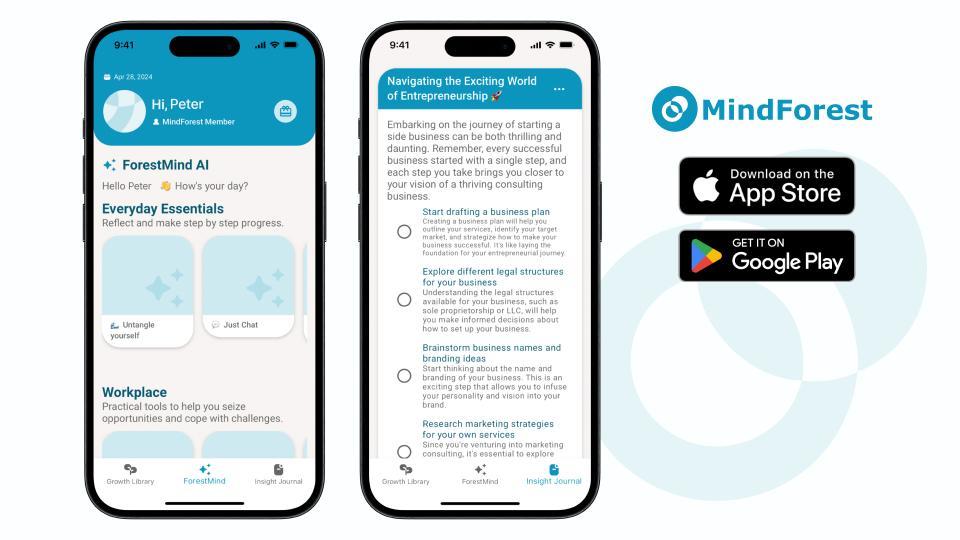
Becoming influential and persuading others effectively requires strong communication skills, particularly empathy and active listening. MindForest can help you develop these skills to improve your business interactions and leadership capabilities.
1) Goal Setting and Tracking for Persuasive Communication
Define your communication goals with MindForest. Whether you aim to enhance your empathy, improve active listening, or refine your persuasion techniques, the app helps you set clear objectives and track progress.
2) AI-Driven Scenario Analysis for Real-Life Persuasion Practice
MindForest offers AI-driven simulations that mimic real-world business situations. Engage in interactive roleplays where you practice persuasion techniques, test active listening skills, and apply empathy in high-stakes conversations.
3) Reflective Insight Journal to Strengthen Empathy and Active Listening
Utilise MindForest’s journaling feature to analyse past interactions, assess your listening habits, and track moments where empathy played a key role in persuasion.
Download MindForest today to master persuasion through empathy and active listening, and become a more impactful communicator in business.
The True Meaning of Influence: Persuasion Through Empathy and Active Listening
At its core, persuasion is about influence—not through pressure, but through connection. The best communicators are not those who dominate conversations, but those who make others feel heard and understood through empathy and active listening. When you adopt an empathetic approach, people are more likely to trust and follow your recommendations.
The question to ask yourself is: Do I want to be someone who talks well, or someone who truly influences others through empathy and active listening? The answer lies in being open to understanding others, rather than just seeking to be understood.
Start listening, start understanding, and see how persuasion becomes effortless and natural with empathy and active listening.
References
Solms, L., Koen, J., van Vianen, A. E. M., Theeboom, T., Beersma, B., de Pagter, A. P. J., & de Hoog, M. (2022). Simply effective? The differential effects of solution-focused and problem-focused coaching questions in a self-coaching writing exercise. Frontiers in psychology, 13, 895439. https://doi.org/10.3389/fpsyg.2022.895439
Weger, H., Castle Bell, G., Minei, E. M., & Robinson, M. C. (2014). The Relative Effectiveness of Active Listening in Initial Interactions. International Journal of Listening, 28(1), 13–31. https://doi.org/10.1080/10904018.2013.813234
Woodward, A. L., & Gerson, S. A. (2014). Mirroring and the development of action understanding. Philosophical transactions of the Royal Society of London. Series B, Biological sciences, 369(1644), 20130181. https://doi.org/10.1098/rstb.2013.0181
Want to understand yourself better? Download MindForest — a psychology-based AI self-discovery app to explore your inner world and manage emotions, anytime.
Discover practical psychology tips you can apply to your everyday life. From building resilience to improving relationships and finding work-life balance, our blog brings expert-backed insights that help you grow.
Personal Branding Is Self-Knowledge, Not Self-Promotion: A Psychology-Based Guide
Personal branding is not packaging — it is the impression your values leave on other people. A psychology-based guide to what a personal brand actually is, why it matters in an unstable job market, and four steps to build one without pretending to be someone else.
Age Gap in Dating: Does It Actually Matter? Here's What the Research Says - 5 Things to Consider Before Having a Relationship
So, You're Dating Someone Older (or Younger) — and People Have Opinions
Let's be honest. The moment someone finds out there is a notable age gap in your relationship, the questions start. "How old is he?" "Isn't that a bit weird?" "What do you two even have in common?" Whether you are 23 dating a 35-year-old, or 30 and seeing someone who is 42, you have probably felt the weight of other people's opinions before you have even had a chance to figure out how you feel yourself.
Here is the thing: age gap relationships are far more common than people make them sound, and the research on them is a lot more nuanced than your group chat might be. This article is here to give you the honest psychological picture — the real concerns, the genuine green flags, and the questions worth asking yourself before you let someone else's raised eyebrow become your own inner doubt.
5 Signs of Love Bombing: When Someone's "Perfect Partner" Energy Is Actually a Red Flag
Picture this. You match with someone, and within 48 hours they're texting you paragraphs. By week two, they're calling you their soulmate. By week three, they've already booked a couples' trip and introduced you to their mum. Your friends are screaming "run" whilst your brain is flooded with dopamine and your heart is doing something completely unhinged.
Here is the plot twist nobody tells you: that overwhelming, electric, "finally someone who gets me" feeling? It might not be romance. It might be love bombing — and once you know what to look for, you literally cannot unsee it.
This article breaks down exactly what love bombing is, why your brain falls for it every single time, and what to actually do if you think you're in the middle of it. No fluff. Just the honest, researched stuff you actually need.